That question reframes a routine action—clicking “download”—into a decision with measurable threat surfaces and operational consequences. For many U.S. users the attraction is straightforward: a browser-extension wallet that supports multiple chains promises convenience, fast DeFi interactions, and a single signing interface across Ethereum, Layer‑2s and EVM‑compatible networks. But convenience concentrates risk. The technical choices made by a wallet provider, and the practical habits of users, determine whether that convenience becomes leverage for autonomy or an amplified vector for loss.
This guest post walks through how Rabby positions itself as a multi‑chain, browser extension DeFi wallet, what mechanisms determine its security model, where things commonly break, and a compact checklist for safer adoption. I’ll assume you know the basics of private keys and browser extensions; the goal is to replace a fuzzy fear of “hacks” with a crisp map of attack surfaces, verification steps, and trade‑offs you can act on today.
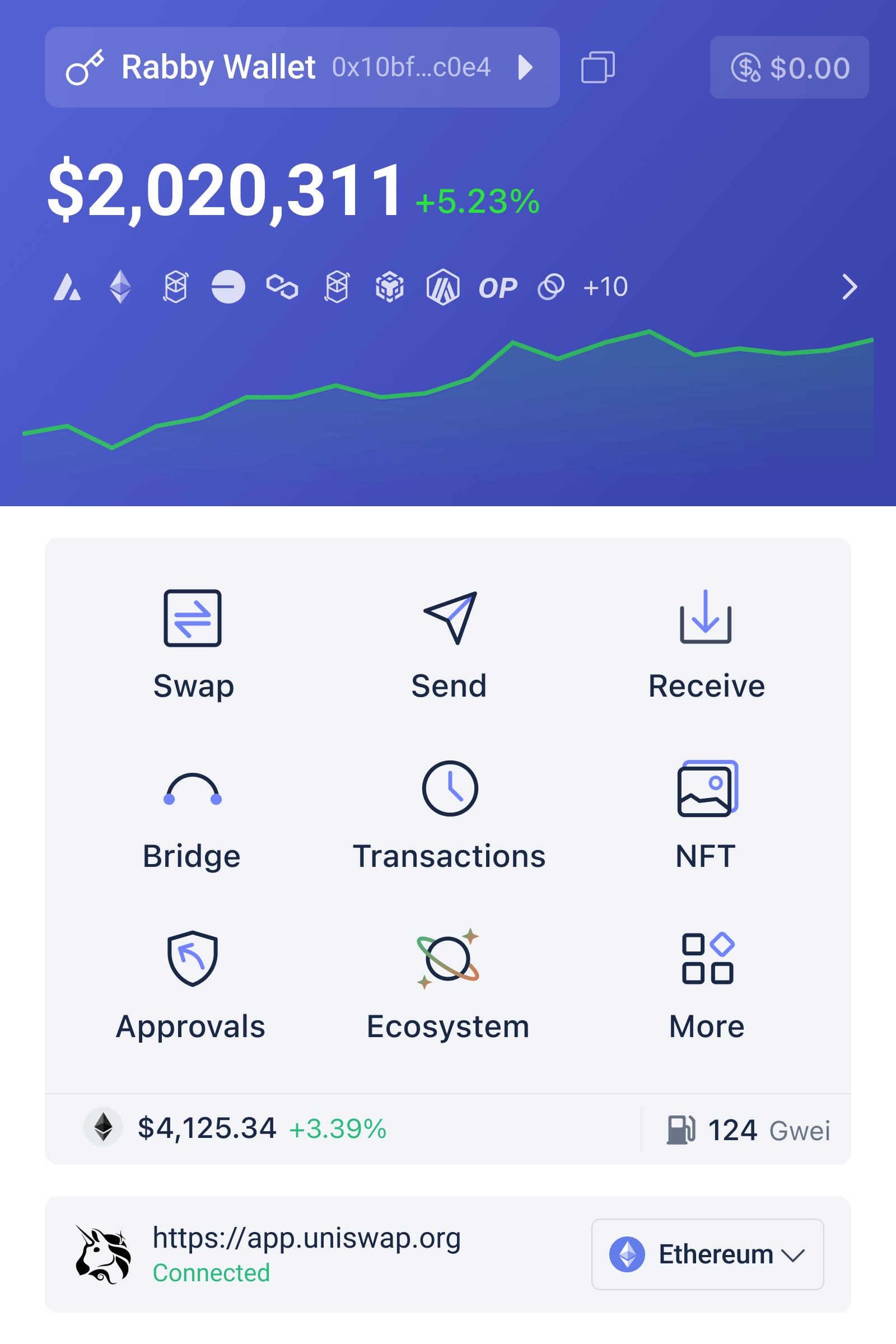
How Rabby and similar multi‑chain extension wallets work: mechanisms not slogans
At core, a browser extension wallet like Rabby stores an encrypted private key (or a seed phrase derived key set) in the browser environment and exposes a JavaScript API that web pages can call to request signatures. It sits between three domains of code and control: the user interface (what you see in the extension pop‑up), the network interfaces (how it talks to Ethereum, Arbitrum, Optimism, BSC, etc.), and the web page that initiates transactions (DeFi apps, token sites). The wallet’s job is to correctly present transaction details, securely sign using keys, and broadcast transactions through configured RPC endpoints.
That simple picture hides two important mechanisms. First, multi‑chain support requires the wallet to manage different address formats, chain IDs, and gas logic; mistakes here can cause signature replay, incorrect nonce usage, or sending tokens to the wrong chain. Second, browser extension architecture places UI, key storage, and web‑page communication inside the user’s browser process—so a malicious or compromised site, a compromised extension, or an infected browser environment can escalate risks. Understanding these mechanisms explains why the most dangerous incidents are rarely “mysterious hacks” and usually a chain of small, avoidable failures.
Where the risk actually concentrates: verification, permissions, and operational discipline
Most security problems reduce to one of three practical failures: (1) users don’t verify the binary or extension source, (2) users approve excessive permissions or open-ended transaction requests, and (3) users operate in an insecure environment (phished extension, compromised device, or mixed trusted/untrusted browsing). For a specific download path—especially an archived PDF landing page that aggregates resources—you should treat the link and the extension installer as two separate verification tasks.
A practical first step is to use authoritative sources to verify checksums or signatures where available. If you arrived through an archived page, consider it a pointer, not the authoritative installer. You can use the archived PDF as a documented resource about what the project claims, but cross‑check the extension ID in your browser store (Chrome Web Store or Firefox Add‑ons) and prefer direct store installation whenever possible to reduce man‑in‑the‑middle risk. For convenience, archival pages like the one linked here can be kept as an offline reference: rabby.
Trade‑offs: convenience vs. compartmentalization
Multi‑chain wallets trade perimeter simplicity for an enlarged attack surface. Supporting many chains means the wallet interfaces with many RPC endpoints, may cache more approvals, and often implements features to switch networks for better UX. That helps users who interact across L1 and multiple L2s, but it also centralizes exploitable behavior—one compromised approval on any chain can expose tokens across chains if cross‑chain bridges or approvals are misused.
By contrast, compartmentalization (using separate wallets or browser profiles per chain/purpose) reduces blast radius but adds friction. The right choice depends on your threat model. If you hold small amounts and prioritize speed, a single multi‑chain wallet with strict approval hygiene may be acceptable. If you manage high balances or offer custody responsibilities, segregate: a hardware wallet for large holdings, a dedicated extension for day‑trading, and throwaway wallets for airdrops or high‑risk contracts.
Verification checklist before you download and connect
Here is a concise, decision‑useful checklist I use and recommend:
- Confirm installer identity: compare extension ID and publisher name in the browser store to the project’s official site (or archived official PDFs) and community channels.
- Prefer signed releases or store installs; avoid random GitHub builds unless you can verify commit signatures.
- Review requested permissions: reject blanket message reading/writing requests unless the feature requires it and you consent intentionally.
- Practice “approve on demand”: never pre‑approve unlimited token allowances. Use wallet features (or token UI’s allowance slider) to limit approvals to necessary amounts.
- Keep a separate browser profile for high‑risk browsing (airdrop sites, unknown dApps) and a clean profile for signing with your main wallet.
- Use hardware wallet integration where supported for large transfers; treat browser extension signing as higher‑risk routine signing.
Where things commonly break — and what to watch next
Empirical patterns from incidents in the ecosystem show recurring failure modes: phishing pages mimicking wallet UIs, malicious extensions that replace legitimate ones in stores, and social engineering that tricks users into approving signed transactions that are actually token transfers. Expect attackers to keep refining social engineering—so the non‑technical defenses (habits, verification steps) often block more attacks than any single technical control.
Two signals to watch in the coming months: first, how wallets design UX to make approvals more granular by default. If major wallets start defaulting to single‑use approvals and show clear human‑readable descriptors for contract calls, the average incident rate should fall. Second, regulatory and store‑policies may change store vetting; stronger vendor verification reduces fake extension risk but cannot eliminate user deception. Both signals depend on incentives: UX improvements cost development time; store enforcement depends on platform priorities.
Limitations and honest uncertainties
We face information limits. An archived PDF or weekly news snippets provides snapshots but not a full audit trail—so don’t treat any single document as proof of security. Additionally, browser extension environments are evolving: browsers change extension APIs, and L2/bridge designs change interoperability semantics. Those changes can introduce subtle bugs that even a carefully coded extension might inherit from upstream libraries or RPC providers. For this reason, assume persistent residual risk and manage it through operational choices rather than absolute trust.
Finally, the security of any wallet depends heavily on user behavior. Even the most audited wallet loses to a user typing their mnemonic into a phishing form. Mechanism-level fixes (hardware signing, transaction decoding, permissions defaults) help but cannot fully remove the human element.
FAQ
Q: Is it safer to download Rabby from an archived PDF landing page rather than the browser store?
A: An archived PDF is useful for documentation and verifying claims, but it is not a substitute for installing from a trusted browser store or a project‑controlled signed release. Use the PDF as a reference and cross‑check the extension’s store listing and publisher ID before installing. Treat archives as evidence, not as the installation source.
Q: If I use Rabby as my only wallet, what daily habits reduce my risk most effectively?
A: Three habits move the needle: (1) inspect every transaction in the extension popup—check destination address and action; (2) avoid approving unlimited token allowances; use minimal, explicit approvals; (3) separate browsing contexts—one profile for high‑trust operations and another for exploratory dApps. Combine these with periodic audits of allowances and a hardware wallet for large balances.
Q: Can a malicious website steal funds even if the wallet is legitimate?
A: Yes, but not without your signature. Malicious sites can craft transactions that look benign but perform harmful actions (transfer tokens, grant approvals). That’s why the wallet’s transaction display and your habit of reading prompts are crucial. Technical defenses like transaction decoding reduce risk but cannot eliminate deceptive contract calls; user judgment remains the last line of defense.
Q: Should I use a hardware wallet with Rabby?
A: If Rabby supports hardware integration for the chains you use, pairing a hardware wallet with Rabby is a strong risk‑management move. It isolates the signing key from the browser environment, so even if the extension or a malicious site requests a signature, the hardware device enforces a physical confirmation step and shows transaction details on its screen.
Download decisions in DeFi are not binary. They are a series of layered choices about trust, convenience, and risk appetite. If you’re exploring Rabby from an archived page, use that document as an evidence point, verify installers against official channels, compartmentalize high‑value assets, and adopt tight approval discipline. Do that, and a multi‑chain browser wallet can be a practical tool rather than a single point of catastrophic failure.
For an archived copy of the project’s download and extension information you can consult the preserved PDF here: rabby. Keep in mind that archived materials may describe past states; always reconcile them with the current extension listing and your operational checklist before you sign your first transaction.
In the U.S. context, where regulatory scrutiny and platform enforcement evolve, staying skeptical, verifying installers, and preferring hardware isolation for significant holdings will remain robust, cost‑effective risk controls. Expect incremental UX progress from wallets and incremental regulatory attention from platforms—both will influence where the next set of wallet compromises will occur, and both are worth monitoring.