Surprising statistic to start: a large fraction of costly DeFi losses come from “blind signing” — approving transactions or token allowances without knowing precisely what will change in your balances. Rabby’s defining response to that problem is not marketing language but a concrete mechanism: it simulates transactions and shows exact estimated balance deltas before you sign. For a DeFi power user juggling dozens of positions across layers and chains, that single feature can change the calculus of risk versus convenience.
This piece compares Rabby’s Chrome (Chromium-based) extension against close alternatives, explains how its core mechanisms work, lays out practical trade-offs for US-based users, and finishes with a short decision framework you can reuse when choosing or configuring a multi-chain wallet.
How Rabby’s distinguishing mechanisms actually work
At a systems level Rabby is a browser extension (Chrome, Brave, Edge) that integrates multiple defensive layers between your key and the dApp. The two most consequential mechanisms are automatic network switching and pre-transaction simulation. Automatic network switching maps the visited dApp’s chain to the extension’s active RPC and switches the extension’s context so the dApp sees the right chain without you manually changing networks. That reduces user error — a common cause of failed transactions or accidental use of the wrong token on the wrong chain.
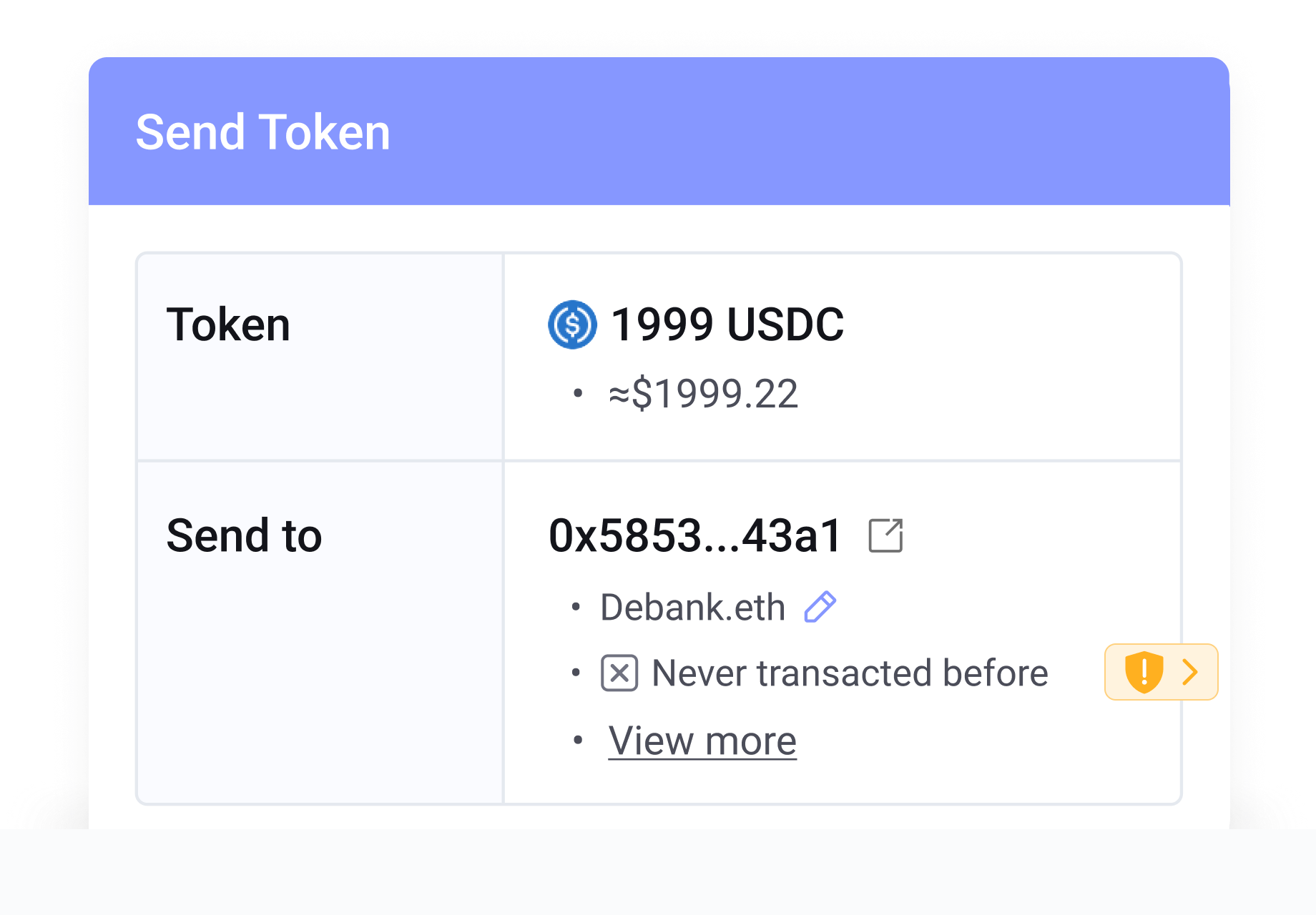
Pre-transaction simulation is more technical but easier to evaluate materially: before signing, Rabby replays the intended transaction against a local or remote simulation engine and reports the expected token inflows/outflows and gas cost. This is not merely a “warning label”; it translates raw calldata and contract interactions into the exact expected balance changes, which lets you spot suspicious transfers, missing returns from a swap, or hidden fees. Combined with Rabby’s security engine — which flags previously hacked contracts, suspicious approval requests, or non-existent recipient addresses — you get a human-readable decision surface instead of raw hexadecimal you’d otherwise have to interpret mentally.
Side-by-side: Rabby extension vs. common alternatives
Comparing Rabby to MetaMask, Trust Wallet, and Coinbase Wallet is useful because each represents a different trade-off between ubiquity, simplicity, and safety features.
– MetaMask: the lingua franca of EVM wallets. It’s ubiquitous and supported by almost every dApp. But it relies on the user to pick the correct network and historically exposed users to blind-signing risks unless augmented with extra tooling. Rabby’s advantage is the simulation + automatic network switching; its “Flip” toggle even lets you swap which extension is the default, easing migration for experienced MetaMask users.
– Trust Wallet and Coinbase Wallet: mobile-first, easy on-ramping pathways, tight fiat rails (especially Coinbase), and consumer-focused UX. Rabby currently lacks a built-in fiat on‑ramp and native staking inside the wallet — a notable limitation for users who want a one-stop experience for on-ramps and staking. For US users who rely on bank-linked fiat purchase inside the wallet, Rabby may require an additional custodial step outside the extension.
– Institutional toolchain (Gnosis Safe, Fireblocks): Rabby integrates with multi-sig and custodial services, which makes it compatible with institutional flows and custody providers. This is a strength for teams who need enterprise-grade key control while keeping the simulation and revocation tools available.
Security trade-offs and historical context
No wallet is risk-free. Rabby is open-source under MIT, which is a plus because independent auditors can and do review the code. It also supports Ledger, Trezor, Keystone and other hardware wallets so you can keep private keys isolated. Rabby provides a built‑in approval revocation UI to cancel lingering token allowances — a practical defense against creeping exposure.
At the same time, Rabby has a recorded incident: in 2022 a smart contract associated with Rabby Swap was exploited for roughly $190,000. The team froze the contract, compensated users, and strengthened audits — actions consistent with responsible incident response — but the episode is a reminder that protocol- and contract-level risk remains separate from wallet UX risk. Simulation and revocation tools reduce the surface for social-engineering and careless approvals, but they do not eliminate vulnerabilities in the contracts you interact with.
Where it breaks: limitations and boundary conditions
Understand the limits before you rely on Rabby as a single source of truth. First, simulations depend on accurate RPC data and the assumptions used to execute a dry-run. Front-running, mempool dynamics, or a state change between simulation and mining can still create divergence — you should treat simulation as a high‑quality forecast, not a guarantee. Second, Rabby does not include fiat on‑ramps or native staking, so US users seeking an integrated buy-and-stake flow must use external services and bridge assets into Rabby-managed addresses. Third, while automatic network switching reduces user friction, it can be confusing in rare edge-cases where a dApp’s RPC mapping is incorrect or intentionally deceptive; always verify the network and contract address in the extension’s UI for high-value transactions.
Decision framework: when to prefer Rabby extension
If you fit any of these profiles Rabby is worth strong consideration:
– You actively trade or use DeFi across multiple EVM chains and want a deterministic preview of balance changes before signing.
– Your threat model includes accidental over-approvals and you want in‑extension allowlist/revoke controls.
– You use hardware wallets, multi-sig, or institutional custody and want a compatible, simulation-first UI that integrates with those solutions.
Conversely, choose a different tool if you require a wallet that handles fiat purchases directly inside the app, or if you prefer a mobile-first custody flow where fiat rails are tightly integrated.
If you want to evaluate Rabby quickly, start with the browser extension on a Chromium-based browser, import a non-primary account, link a hardware signer if you use one, and test the simulation with a low-value swap so you can see how balance deltas and gas are reported.
Practical heuristics and what to watch next
Here are four heuristics to use every time you interact with a dApp via a wallet like Rabby:
1) Always inspect the simulation’s balance delta. If the token you expect to receive is missing or the recipient address differs, pause.
2) Use the revocation tool monthly to clear stale allowances, especially for DEXes and aggregator contracts.
3) Keep a hardware wallet for any address holding significant capital and use Rabby as a UX layer rather than the primary key store.
4) For cross-chain work, confirm gas-top-up behavior in low-value tests: cross-chain gas transfer can be subtle and some bridges or chains have rate limits or delays.
Monitor these signals for Rabby’s future direction: deeper fiat integrations, first-party staking, or additional formal verification tooling would change its competitive profile. The team’s recent positioning as “go-to for Ethereum and EVM” suggests continued investment in EVM usability; whether that expands to fiat and staking remains an open question tied to regulatory choices and product priorities.
Quick how-to: install and test the Chrome extension
For a responsible test in the US: install the extension on Chrome/Brave/Edge, create or import a test account using a seed you control (never expose your main seed), connect a hardware wallet if available, and run a small swap on a familiar DEX. Observe the simulation, check the flagged risks, and revoke any approvals you used for the test. For the official download path and documentation, see the vendor page for rabby wallet.
FAQ
Does Rabby prevent all smart contract exploits?
No. Rabby reduces user-level risk by simulating transactions, flagging suspicious contracts, and enabling approval revocation, but it cannot stop vulnerabilities inside third‑party smart contracts or guarantee that a state change won’t affect an executed transaction. Treat simulation as a strong but fallible risk filter.
Can I use Rabby with a hardware wallet?
Yes. Rabby supports Ledger, Trezor, Keystone and several other hardware devices. Using a hardware signer combines Rabby’s UX with the private-key isolation of a hardware wallet — a recommended setup for significant holdings.
Is Rabby a custodial wallet?
No. Rabby is non-custodial: private keys remain under the user’s control. It also integrates with institutional custody and multi-sig solutions for team or corporate workflows.
Does Rabby support chains beyond Ethereum?
Yes. Rabby supports over 90 EVM-compatible chains including BNB Chain, Arbitrum, Optimism, Polygon and Avalanche. Its automatic network switching is particularly helpful when you move between these environments frequently.